Plastic reservoir hot plate welding is suitable for evaluation when compatible molded halves have a continuous weld seam and can be supported during heating and joining. Automotive reservoir welding must meet the specified sealing, strength and dimensional requirements. A coolant reservoir, expansion tank and washer tank can have different service conditions, so each drawing needs its own acceptance plan.
Identify the exact resin grade of both halves, including fillers, additives and permitted recycled content. PP and HDPE describe material families; their names alone do not prove weldability. Review production samples, moisture requirements and molding variation before choosing a recipe.
Inspect the seam cross section, contact land, wall thickness and flash allowance. The tank welding fixture should support the joint without forcing warped parts into an artificial shape. Check ports, mounting bosses and tool access. TWI describes heated tooling and joint support; these principles help assess whether the actual part can be held and heated consistently.
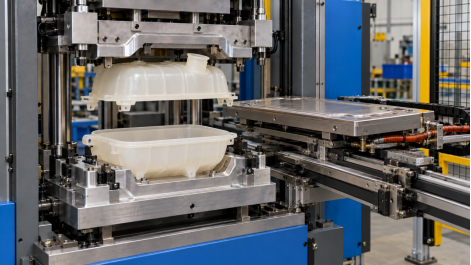
AI-generated application illustration of reservoir tooling with the horizontal hot plate retracted. Geometry and machine details require project engineering.
In a hot plate welding machine, heated tooling melts both mating surfaces. The tool then withdraws and the molten faces meet under controlled joining force or position. The assembly remains supported during cooling. Record temperature by zone, melt development, transfer time, weld collapse and cooling time. Investigate inconsistent contact or delayed transfer before increasing temperature.
During process-window trials, compare nominal settings with nearby conditions agreed by the supplier. Measure heater surface temperature and melt displacement at relevant seam regions, then connect each sample to weld strength testing and leak results. If one corner repeatedly fails, investigate thermal uniformity, local wall thickness and fixture contact there. Keep material batch, cavity and part temperature identifiable. Establish the qualified window with production-equivalent parts and the customer's acceptance limits.
For servo hot plate welding, agree the required motion profiles and position feedback. Pneumatic equipment may also suit a validated application. Select the architecture from seam behavior, dimensional limits and the complete station cycle. Our hot plate welding guide covers the broader process comparison.
Define test pressure, fill time, stabilization time, measurement time and the reject limit with the customer. A pressure decay leak test observes pressure loss after isolation from the air supply. State whether acceptance uses pressure loss or a calibrated leak rate, with units and reference conditions. CTS explains the setup variables.
Control the reservoir temperature after welding. Cooling air and elastic wall movement can change pressure during measurement. CTS identifies temperature and volume effects in differential pressure decay testing. Establish the cooling and stabilization conditions experimentally; a shorter timer needs evidence that the test still distinguishes acceptable parts from relevant leaks.
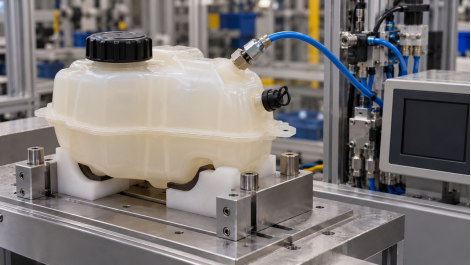
AI-generated application illustration of a reservoir leak-test setup. No measured leak rate or acceptance result is shown.
|
Observation |
Checks to prioritize |
|
Local seam leakage |
Part seating, heated-tool contact, local melt development and joint alignment. |
|
Variable test results |
Part temperature, stabilization, port sealing and leak testing fixture connections. |
|
Distortion or heavy flash |
Incoming warpage, support, melt displacement, joining force and final position. |
Compare a verified non-leaking master and an appropriate reference leak under the test supplier's procedure. Check seals and connectors before attributing every reject to the weld. Ensure the test fixture does not mechanically close the seam defect being evaluated. Retain rejected parts with their weld and test records.
A leak test checks tightness under its defined conditions. Joint strength, burst testing, fluid exposure and thermal cycling are separate requirements when specified. Agree the sample plan and conditioning before the factory acceptance test. Include cold starts, material variation and tool changes relevant to production.
Dizo Sonics provides automotive plastic tank hot plate welding machines and servo hot plate platforms. Integrated leak testing, data export and handling are project options. To specify a plastic tank welding machine, provide:
Contact Dizo Sonics with the part family and test specification for a review of tooling, thermal controls and the proposed welding-and-inspection sequence.


